Words by Giles Tettey Nartey
‘An Offering presents a series of sculptural works by Jan Hendzel. His practice unfolds between material knowledge and the act of making, brought together through an engagement with process and labour. The exhibition brings together a set of totemic works, accompanied by process models and functional objects, establishing a dialogue between sculpture, architecture, and the votive dimensions of making. Viewers enter an intimate space where the works operate collectively as an offering.
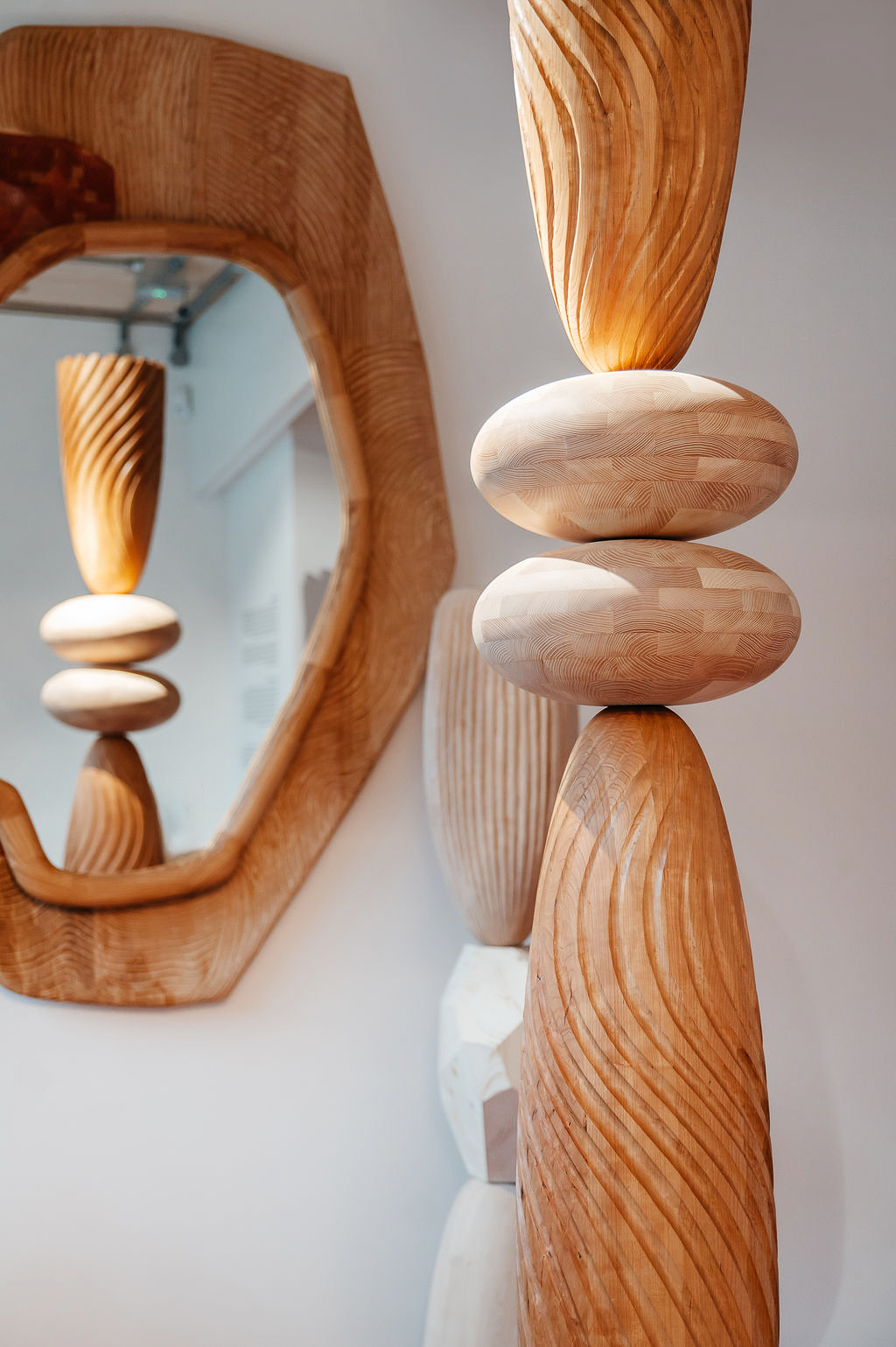
Across many cultural contexts, totems have held communal memory and belief, encoded social relations, and functioned as instruments of measure that mark space. Hendzel translates this lineage into abstraction. Each work stands as a figure within the collective space. Together, they establish a rhythm that organises movement. The sculptures are composed through a logic Hendzel refers to as Timber and Technique. He works with freshly sawn cedar and seasoned British-grown ash. Some works are lathe-turned, while others operate as multi-compositional assemblies, where parts are stacked and offset. The materials carry scent as much as structure. Cedar’s sweetness carries a particular nostalgia: the scent of sheds, workshops, and formative spaces of making, where timber becomes bound to memory.
The selection of works to accompany the totems was centred on two ideas: textural interplay, and the continuation of a language that translates across the functional and the sculptural and the space between, which I continue to understand as a process. I selected the works for how they speak across one another through variation and drift. That drift matters: a technique reappears in a different register; a groove becomes structural; a surface becomes a drawing, then a joint. The selection method tracked continuity, locating where decisions repeat, where they sharpen, and where they open into a new condition.
For me, Hendzel’s approach aligns closely with the sculptural investigations of Constantin Brancusi, who treated carving as a direct and generative process through which form emerges through contact between hand, tool, and material. Hendzel’s sculptures develop as multi-compositional works through incremental actions of stacking, turning, carving, and aligning sections of wood, foregrounding making as a votive practice between hand, tool, material, and rhythm. This rhythm matters. Music accompanies Hendzel’s making process, and sound and timing sit at the centre of his method; the sculptures reflect that rhythmic logic in the space.
I was particularly drawn to work that expands the ideas and techniques already latent in the three totemic works: balance, composition, grooves, scoring, and the tension between the marked and the smooth. I kept returning to the question of how a language holds together while its function shifts. The works I selected answered that question through material decisions.’
Gallery Address: 134 Old Street, London, EC1V 9BL